
Dundee Mountain Film Festival
5th – 7th December 2024
Note that due to the Bonar Hall not being available, we have switched the venue for 2024 to the Dalhousie Building at Dundee University. The festival will also be a week later, 5th to 7th December 2024
Our 2023 festival is over! Thanks to all the speakers, film makers, trade and voluntary organisations, and all the volunteers who make the event such a success.
Also thanks to the venue staff at the Steps Theatre and Bonar Hall.
With a new projector, our films looked better than ever, thanks to our hard working staff at Event Tech-Style Ltd. (Ewan, Eleanor, Mike and Neil).
Also Dundee Rep for the catering at the interval
And to you, the audience, for your support in making the event such a success. We are looking for people to join us in organising the event (there are only a handful of us!), so please get in touch if you are interested. The more of us there are, the better we can spread the workload, and bring fresh ideas to the organisation.
A fuller list of thanks and acknowledgements are on our acknowledgements page.
People’s Choice
 Our Peoples Choice film, voted for by you was Solo, which we screened on Friday Evening. The votes were very close this year with The Nine Wheels and A New Way Up being just pipped at the post. You can view The Nine Wheels and A New Way Up from our film archive page
Rewatch most of the 2023 films and more
Stuck at home? Bored? Check out our Film Archive page. (updated 19 April 2024)
Really bored? You can browse through our old brochures and bring back memories. Our records are incomplete so if you have one of the brochures we don’t have we would like to borrow it, scan and return.
Sponsorship
We invite potential sponsors to discuss participation in our exciting film festival. You can download a sponsorship package here.
We also have sponsorship opportunities for clubs, namely for supporting a film – download the package here.
Film Submission
Although we do not have a film competition, we welcome approaches from film makers wishing to consider using the Dundee Mountain Film Festival as a showcase for their films. We often have representatives from other film festivals and film makers attending the DMFF.
You are welcome to submit films to us for our 40th event in November 2024, using FilmFreeway or just email. We are looking forward in reviewing your films.

If you don’t want to use FilmFreeway, you can email allan@dmff.org.uk
Follow us on Facebook and Twitter




See us on Flickr
A link to our Flickr photostream. Open, then click on “Albums” to sort the photographs by year/festival. If you want to use any of these photographs please let us know first and and credit Dundee Mountain Film Festival as owners. There are no charges or formalities though, its just nice to know how they are being used!
Acknowledgements for the photographs in the 2023 brochure page headers and poster, also music
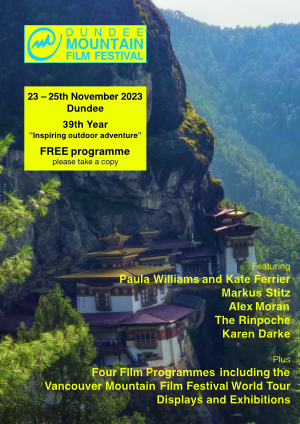
Brochure/Poster photograph – Taktsang Monastery (Tigers Nest) Bhutan – John Baikie
Brochure page headers – Markus Stitz
Karen Darke photograph – Christopher Michel
Hamish Frost photograph – Adam Raja
Alex Moran photograph – Hamish Frost
Film “No Lost Shoes” photograph – Max Romey
Film “Solo” photograph – Rachel Keenan
Trailer music – “Scottish Dance” by Zlata Dzardanova (Pond 5)